

PetMatch
An improved pet adoption experience




The Challenge
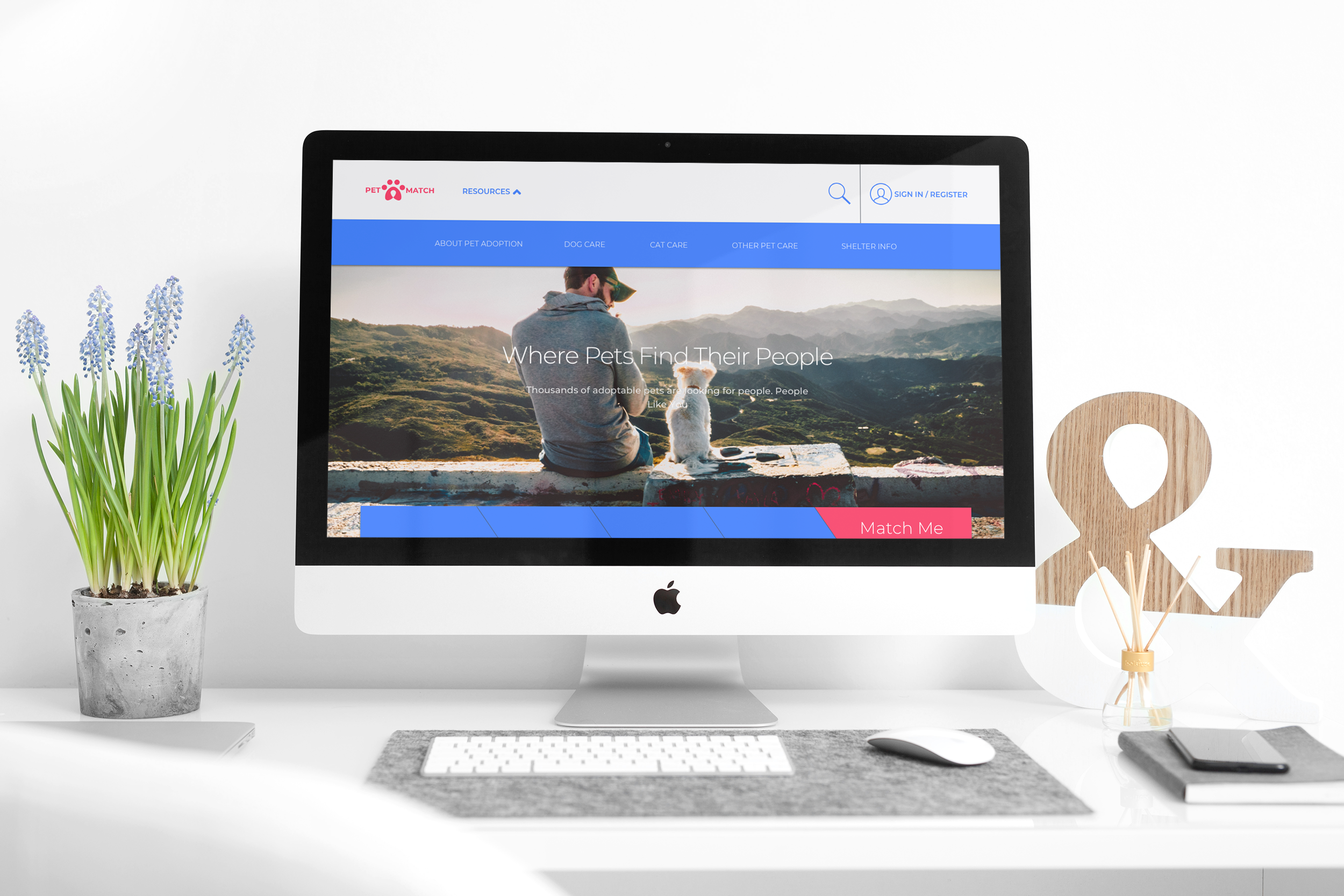
PetMatch is an online pet adoption association designed to increase pet adoption rates from shelters by providing an easy-to-use and personalized experience to help adopters find the right match in a pet. PetMatch allows for users to input data about their circumstances and preferences, which in turn provides tailored pet matches for the user.
Design Process

Discover
Market Research
User Interviews

Define & Ideate
Empathy Map
Persona Development
Storyboard
Task Flow
Design Features

Design
Low-fidelity Wireframes
Logo & Icon Design
UI Kit
High-fidelity Prototype

Test & Iterate
User Tests
Affinity Map
Revisions
Discover

Background
Millions of animals are currently in shelters and foster homes awaiting adoption.
Shelters are overcrowded, and many animals end up getting euthanized. According to the ASPCA:
Around 6.5 million companion animals enter U.S. animal shelters nationwide every year, mostly cats (3.2 million) and dogs (3.3 million).
Each year, about 1.5 million shelter animals are euthanized (670,000 dogs and 860,000 cats) and around 3.2 million shelter animals are adopted.
Breeders and Puppy mills contribute to animal overpopulation, and when someone purchases a puppy or kitten from a breeder, it increases the chances of animals being euthanized.
By partnering with shelters all over the country—and eventually worldwide—PetMatch wants to create a platform that allows people to see all the available animals in any shelter close to them.
Awareness and discoverability are the primary things they want to address.
Market Research
Research Plan here.
LACK OF AWARENESS
Despite the high numbers of animals entering shelters, the ASPCA found that just 23 percent of dogs and 31 percent of cats are adopted from animal shelters and humane societies.
PERSONALIZATION & A GOOD FIT
Current options for finding a pet are limited and impersonal. While there are websites that allow users to search an adoption database, the usability is often lacking.
People want and need a way to determine what animal matches their lifestyle and preferences.
According to the American Humane Association (AHA), 42% of animals are returned to the shelter within 6 months after adoption.
USABILITY
One of the reasons there are so many pets in shelters is because the adoption process is lengthy. The process is unnecessarily complex and potential owners can sometimes be unaware of the financial and social decisions that go into pet adoption.
MILLENNIALS LEAD THE PACK
From the 1990s through 2010, the enormous growth of the pet industry was led by the Baby Boomers, but as they begin to age out, the Millennials have exuberantly taken up the mantle of responsible pet ownership and increased spending, and now represent the most important demographic in the industry.
In 2014, American Millennials spent $10.6 billion on their pets, over 15% of the approximately $60 billion spent on pets that year. (petfoodindustry.com)
Interviews
I conducted 5 user interviews to validate my assumptions and gather firsthand information on potential and prior pet adopters and uncovered their motivations, goals, needs, and frustrations. To gain a deeper perspective on the subject, I also spoke with a local animal shelter employee who helps animals find homes on a daily basis.
Key Findings
MISPERCEPTIONS
Many people believe that animals in shelters are somehow damaged.
EXPECTATIONS AND ASSUMPTIONS
A lot of people are unaware about the adoption process.
Most adopters are surprised by the paperwork, financial burden and amount of steps to adopt a pet.
A big problem shelters face and a major pain point for adopters are the false expectations of being able to walk into a shelter and pick up an animal then and there.
UNINFORMED
Most people don’t ask the shelter employees what animals are right for them. Shelters say they want to find the right adopter, but they really don’t have the time.
Define & ideate
Empathy Map
The research data from the interviews is analyzed to identify similarities/patterns and preference. I then create an empathy map which helps visually organize the findings and uncover insights into our users. It became clear that for a solution that connects people looking for a new pet with their right companion, the role of the shelter workers has to be taken into account as well.
Personas
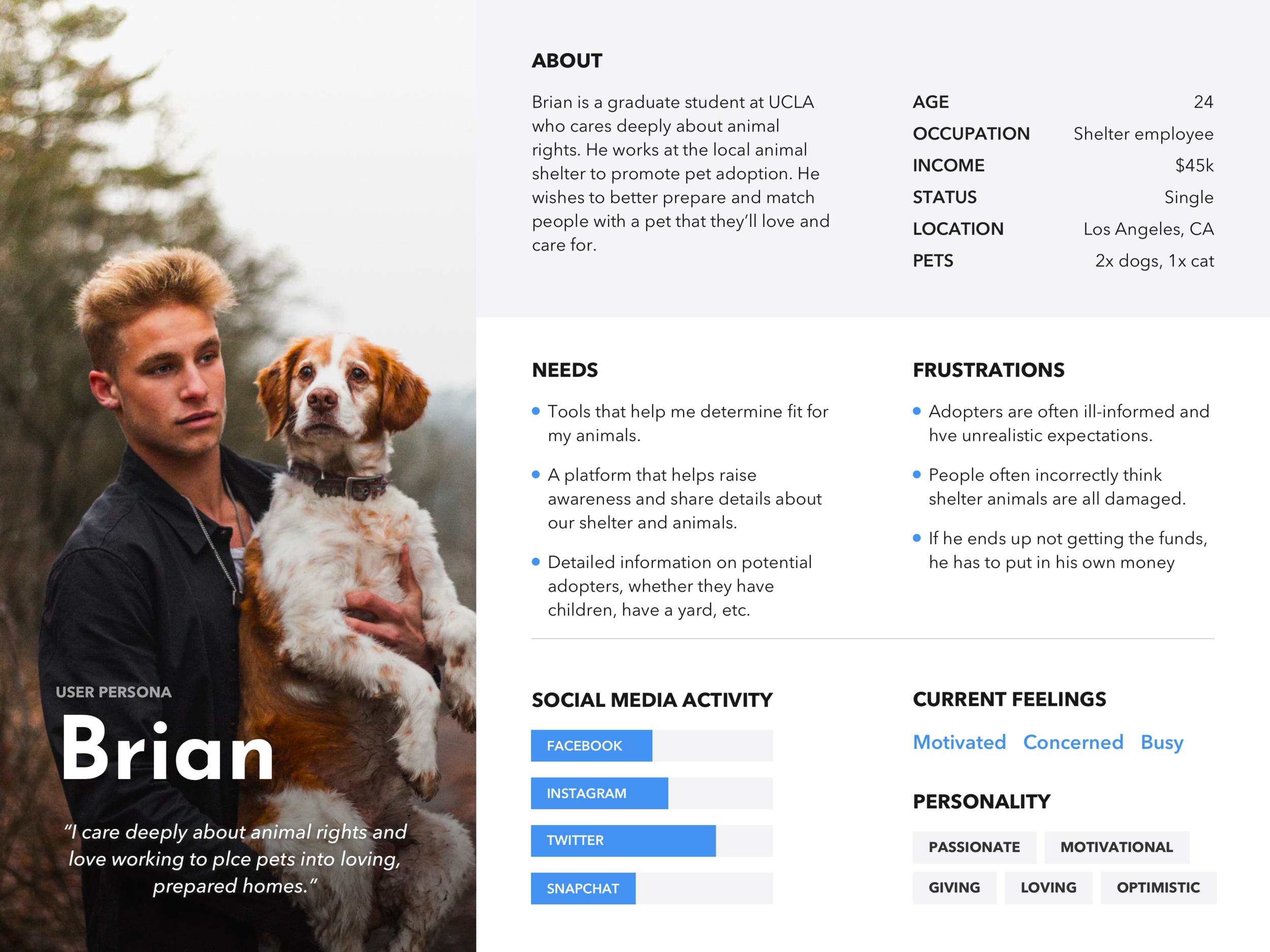
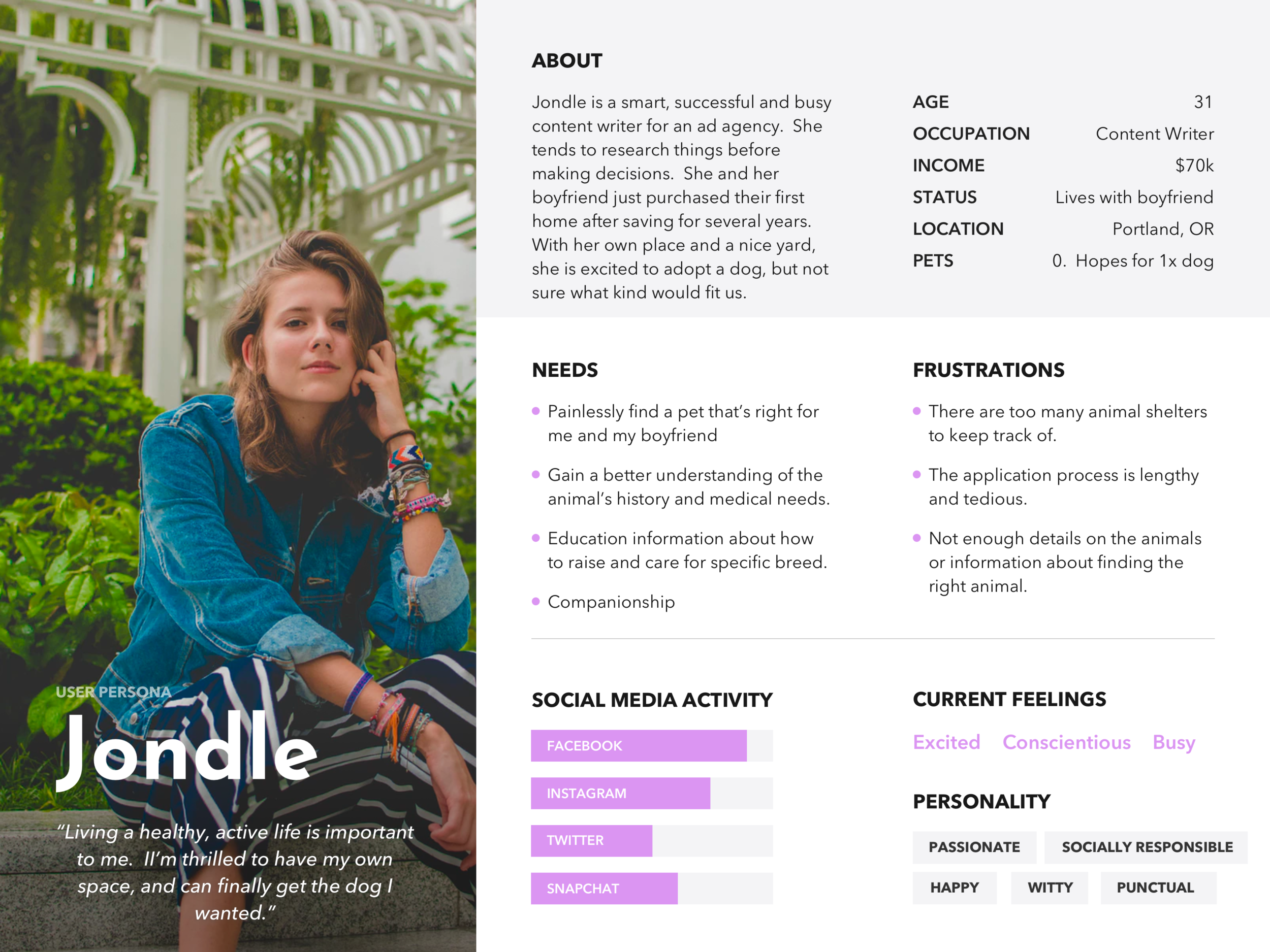
From here, I combine and distill our insights into personas that encompass their shared ideologies and insights. I use the empathy map and personas as a reference point throughout the project to keep me focused on the users for whom I am designing.
Jondle Meets PetMatch
Task Flow
High-level flows allowed me to better understand the solution and pinpoint strengths and weaknesses in it's concept. From there, I continued to brainstorm and refine the idea, always making sure to stay in-line with what the user's needs and goals are.
Pets
Sitemap
Design Features
High-level goals
EDUCATIONAL
In order to convince potential adopters to choose animal shelters over breeders or to strength this existing preference, it’s key to educate about the shelters and their advantages.
The relationship between UX and pet adoption is not just about helping potential owners find the pet that’s right for them, but also about giving these owners the education and tools they need to ensure their adoption is a successful one.
I should seek to educate and provide resources that are specific to the adopter’s situation, such as how to introduce a new pet to existing pets, tips for properly training a puppy, what to expect with senior animals, etc.
SIMPLE & EASY-TO-USE
Shelter employees are busy so the simpler I can make it to upload information the better.
Pet adoption can be an overwhelming process, so it’s important the team is sensitive to how and when they’re presenting information.
Universal applications and free built-in background checks.
RAISE AWARENESS
A blog with articles educating and demonstrating industry leadership.
PERSONALIZED MATCHING
(see below)
'Match Me' will work similar to popular dating sites like OkCupid.
'MATCH ME' Feature
ANIMAL CHARACTERISTICS DATABASE
Different animals have different personalities and mannerisms, are prone to different health conditions, and are better suited to certain situations and settings. PetMatch can create a huge database of known animal and breed characteristics.
PERSONALITY, LIFESTYLE & CIRCUMSTANCE QUESTIONS
Users can answer a series of personality, lifestyle and circumstance questions.
ALGORITHM MATCHING
Using research and shelter input, an algorithm will match users with personalized matches, similar to online dating algorithms.
Design
Low and Mid-Fidelity Responsive Wireframes
Sketch it out
Then digitize
Logo and User Interface (UI)
Hi-Fidelity Prototype
Test & Iterate
Usability Testing
TEST FINDINGS
100% Success rate for all tasks. Flow through the site went well considering most links weren’t clickable and all tasks were completed by all users.
85% Error-free rate.100% liked the graphics and layout.
75% mentioned liking the PetMatch feature.
Recommendations
Allow user to see results without first creating an account.
Separate 'Match Me' and normal Find a Pet flows on homepage.
Redesign Find a Pet UI.
Change questions from buttons to circles with check marks.
Reduce visual impact of image in questions pages
Implementing the Changes
takeaways
This is just the beginning...
A company’s relationship with its customers is a living, breathing thing that needs constant attention. The only way to ensure your customers are being heard is to listen to them regularly. That’s where continuous customer research becomes an important part of your development cycle and encourages a faster, more iterative process.
Shelter-side integration
Besides investing in a responsive website to help people discover animals and learn more about shelters, PetMatch has plans to create a website for shelters to upload animal information easily.
I'll create an Admin platform where shelters and organizations' pet information and photos can be pulled automatically from their sites.
To do this, PetMatch could work with software companies to see how the data could be imported automatically to PetMatch from the local shelter.